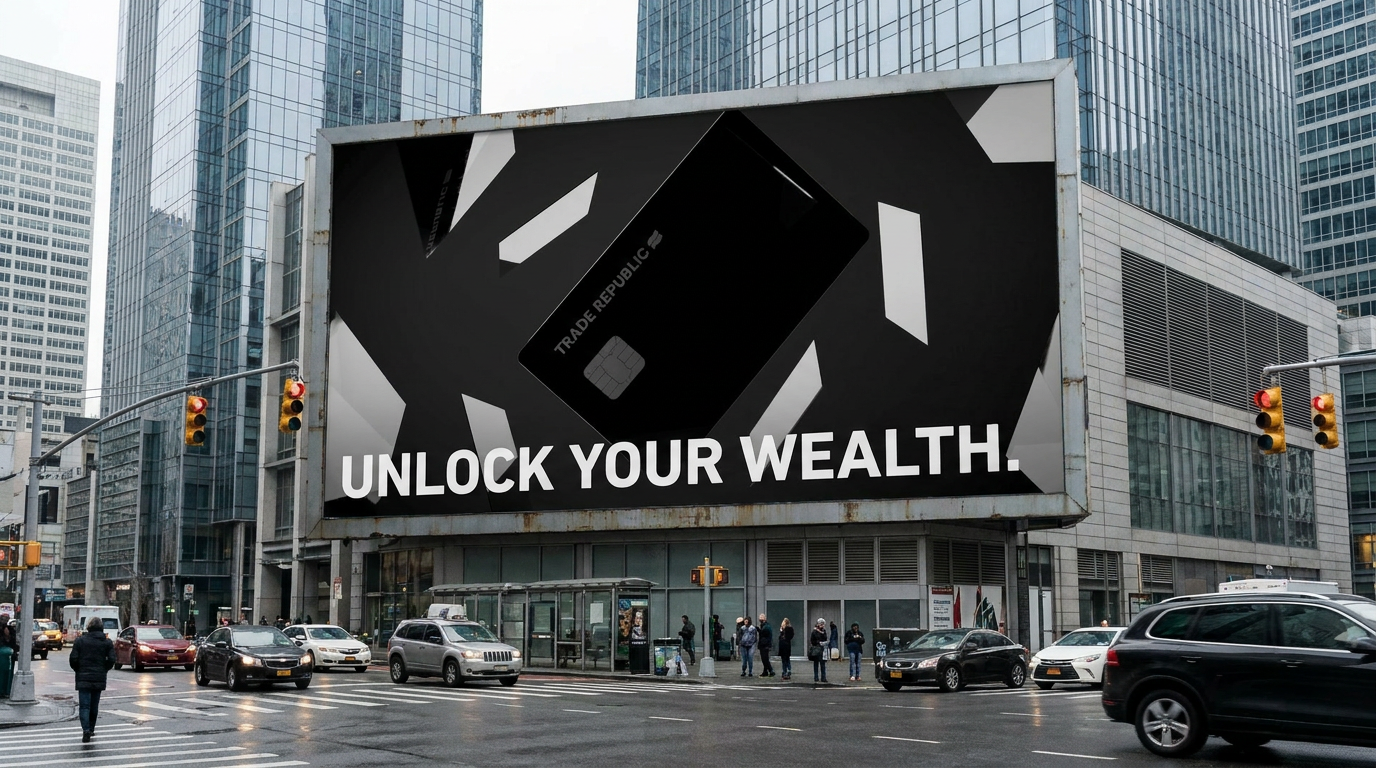
Trade Republic "Mirror"
Problem
Mirror-finish cards are everywhere, but most animations cheat - a looped reflection, a rotating spotlight, a pasted environment map. The surface is treated as a texture problem. It never earns its name because no one asks what it should actually be reflecting.
Solution
Build the environment the card reflects. If the card is a mirror, what it sees matters as much as the card itself. Compose the surroundings as deliberately as the object, then let the card reveal them - colour folding into the surface, the environment becoming the story.
My involvement
End-to-end and self-initiated. Environment design, 3D modelling, chrome material authoring, lighting, animation and final render. The challenge was treating a reflective surface as a compositional tool rather than a finish.
Type
Self-initiated
Year
2026
Research & Rationale
Chrome is not a surface - it's a relationship. The Trade Republic Mirror card has no colour of its own; it borrows everything from its surroundings. That makes this an environment design problem as much as a rendering one. What does the card see? What should fold into its surface? How do you direct attention when the subject is, by definition, everything around it?
The answer was to treat the environment like a stage set - designed independently, lit deliberately, and then introduced to the card. Colour temperature, the geometry of light sources, the softness of reflections - all of it was composed to read beautifully through a chrome surface before a single frame of card animation was rendered.
In its element
A mirror card belongs somewhere worth reflecting. The environment it lives in - the surfaces it catches, the light it borrows - is as much a part of the design as the card itself. That logic carried through to every frame.
Placed in context, the chrome earns its name. Nothing about it is decorative. It simply takes what's around it and gives it back, cleaner and more considered than you left it.